Friday, 22 July 2011
bags not
Earthquakes don't only crack open the earth they also have the ability to crack open our hearts and minds. A lot of wonderful and heart warming things have happened in Christchurch and Lyttelton in response to the earthquake.
One area that has pulled the short straw though has been the environment: every day hundreds of trucks rumble into Lyttelton and disgorge building rubble straight into the water of our harbour; hundreds of old buildings are being destroyed, in the process releasing asbestos, lead paint particles and other chemicals into the air. Every one of the major earthquakes/aftershocks we experienced were over in leass than a minute, but the debris created by the destruction of large parts of the city equals the amount of rubbish that Christchurch usually produces in 20 years.
This makes depressing reading, but we can always come up with positive ideas to counteract this, even if small.
While a lot of the shops, including the supermarket, are still closed on London Street , now might be the time to re-ignite an idea that has been floating around for years: Plastic-bag- free Lyttelton.
A lot has been done overseas to tackle plastic bags:
• Plastic bags are not available in Germany any more unless they are fully biodegradable.
• Ireland and Taiwan both reduced plastic bag usage by more than 90% through a small levy.
There are also a few places in New Zealand that have made steps in this direction:
• Collingwood in Golden Bay is NZ's first plastic-bag free town. Zero Waste funding was gained from Tasman Council for an educational programme including cloth bag painting in all of the Golden Bay schools. The first 1000 bags were handed out to every car entering Collingwood. Following that, surprise visits from the 'Good Green Fairy" rewarded shoppers using their own shopping containers with wonderful donated prizes. http://plasticshoppingbagfree.org.nz
• Waitakere City Council is the first council in NZ whose goal it is to be plastic bag free. Their website gives tips for both customers and retailers, as it is very important to get businesses onboard. Check out http://www.waitakere.govt.nz/abtcit/ec/bagsnot/index.asp
• Plastic Bag free Kaikoura launched 'Fantastic No Plastic!' with a logo, designed by a local High School student, printed on recyclable bags. A colloboration between council and local businesses meant that 10,000 reusable printed bags were purchased and distributed free to each household and to each primary and high school student at presentations held at the schools. The remainder of the bags are being sold to the community through local businesses at a price of $1.50 each.
• Waikouaiti in Coastal Otago has been busy with the same ideas.
In 2008 Project Lyttelton did a survey at the Farmers Market re. Plastic bag free Lyttelton and over 129 of 165 people asked thought reduction of plastic bags was very important and that they would be happy to pay around $2 for a non-plastic bag if available.
A group of women around Project Lyttelton have sewn dozens of cloth bags in the last few years, mainly used to give away as welcome bags to new Lyttelton residents.
So how can we go forward and turn Lyttelton into another plastic bag free town?
written by Bettina Evans
Friday, 15 July 2011
relocalising economies.
I often feel grateful for the good life my family has living in Lyttelton.
The rich web of active local economies that exist here mean that we as a four person family can live on a single income comfortably. We have a quality of life that we wouldn't manage in other places because these human-scaled economies maintain a strong social life here and build healthy, mutually supportive neighbourhoods.
I was reminded of this yesterday.
I spent my day based at home and around this town with my two children as we often do.
We engaged in the myriad of tasks which maintain our household economy, as most of us do on any particular day.
You know most of this list: cook, build, administer healthcare, mend, resolve conflict, grow food, comfort, preserve, make medicine and body products, feed and care for livestock...the list is long.
Although we strive to maintain our household as a unit of production rather than a unit of consumption, none of this counts as part of the "Economy." It's worth however, is obvious and indisputable.
in the morning we picked up firewood from the community garden and took it to a family with a newborn, a request I happened upon on freecycle. Both time and wood was gifted.
Elsewhere in Lyttelton yesterday, the Community House prepared dinner for an armload of people, volunteers organised events, ran the Information Centre, the volunteer fire brigade trained, people took food to their neighbours and others gave food to the community foodbank. These people all took part in the local gift economy.
Gifting is still part of what we do here.
You too might contribute to this foraging economy by hunting, fishing, upcycling, and rescuing mislaid treasures from rubbish skips.
That evening we used Timebank to find someone to be with our girls while we went out. The Timebank is embedded into this community's culture and is a network of people who trade services using time credits rather than cash as the currency.
Other less formal elements of a healthy bartering economy are when we trade or swap goods, share seedlings and simply when we return favours to our friends.
A pot-luck dinner preceded the meeting I went out for. Pot-lucks are a brilliant way that Kiwis "do" collective economies, as are consumer co-ops, community land trusts and any other innovative way we figure out how to pool resources. Here in Lyttelton a group called "The Harbour Pool" is innovating new ways in which we can pool and share financial assets without involving crippling interest. This will provide a model for further groups to set up and keep money circulating and benefiting families in the Harbour.
Lastly a thread strengthening this web of localised economies are the business cooperatives that Project Lyttelton is currently investigating. Community-owned cooperatives are primarily created to serve the members and therefore, benefit a broad sweep of the people living in that particular community rather than a comparatively few investors who may live far away.
As we go about our lives we can be unaware of all these different human-scaled economies that we take part in daily and how these positively affect the quality of our lives. These local economies is what keep people alive when they lose their job or their business; it is these local economies that shone through the chaos of late February here in Lyttelton. Naming and valuing all these local economies helps transform our understanding of wealth and reminds us that we are in fact receiving all the time. Antidotes to a sense of scarcity cultivate empowerment in our lives and lift our spirits.
written by Jacinda Gilligan, also at www.watchingkereru.blogspot.com
Wednesday, 13 July 2011
putting the "community" into the garden
always blessed with a stunning view whatever the weather.
Our community garden has been a source of inspiration, connection, and purpose for me.
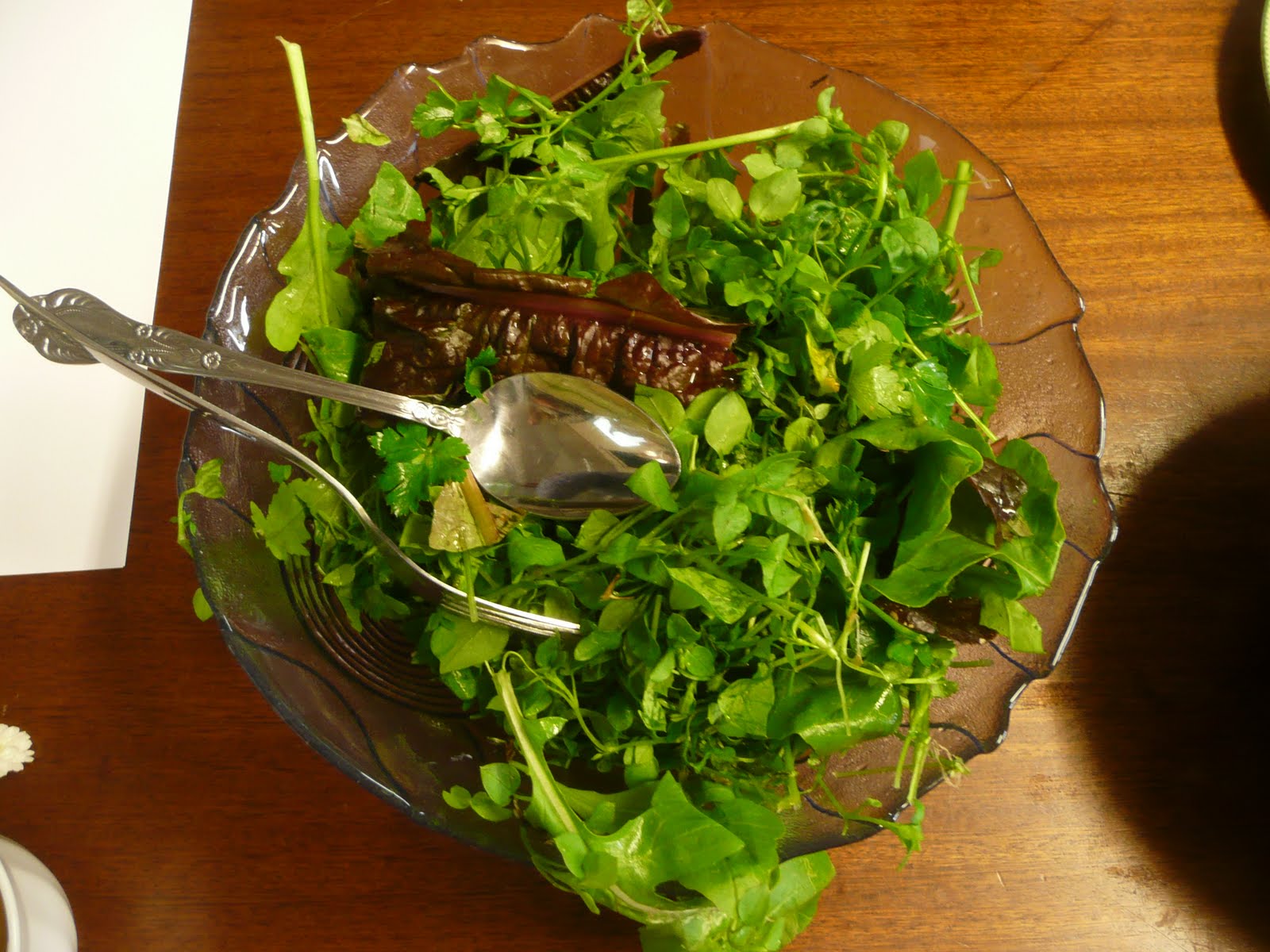
We meet together every Wednesday for some digging in the dirt and then we share a meal together. These days it has been more of sharing the meal than the actual gardening and I am just fine with that – for now. salad greens from the garden - thank goodness for the chickweed right now.
We don’t complain or talk badly of people and new people who come into the group understand that pretty much right away.
We don’t tell them that; they just get it from how things are.
We think of ourselves as ‘chosen’ whanau – not the families we were born into but rather the one we have chosen to be part of as that just feels right.
a range of ages mixing and sharing stories.
That was just over 3 years ago.
Jacinda is a great gardener and so she guides us in many things.
She also inspires me to come with an open heart.
knowledge passed down to the children.
We have tried it this way for a year or so and we find it works pretty well.
chickens integrated into the garden system, scratching up, fertilising and giving us eggs.
I know that we miss things and truthfully our seed sowing this year has been horrible but I also know that when we get our heads back into this, we will be off again. We thought that this Wednesday we should actually focus on either getting seeds sown or planning for the spring sowing – it turns out that we have all pretty much forgotten about sowing.
welcoming all who arrive and pleased to have wee ones in the garden with us.
Today is garden day and I am looking forward to being together. A few of us have been away and so today gives us an opportunity to catch our breaths, breath in together and enjoy being together – silently or noisily however that works out.
We might garden a lot and we might not and for me, that is all ok.
enjoying the seasonal fruits as they last
written by Sarah Van Der Burch
Thursday, 7 July 2011
the list
I read an interesting piece recently which I'd like to write about. It has a connection to our situation in Earthquake Country as it relates to managing or preparing for the stresses and strains that life brings, in so far as one can prepare for these things.
Dr Roger Walsh is Professor of Psychiatry at the University of California, Irvine, and has written about and researched issues around mental health, and health generally for many years. In a piece he has written for the journal American Psuchologist, he points out how 8 simple lifestyle choices can have a profound effect on health, mental and otherwise. His article reviews the research into these issues and makes some telling points.
Looking at the list of lifestyle choices, you would think that its largely a matter of common sense and whats the big deal? Yet Dr Walsh states that only 10% of health professionals recommend these activities to their patients and thats because they themselves do some or all of them. Here are the 8.
Exercise
Nutrition
Nature
Relationships/community
Recreation
Relaxation
Religion/meditation
Service
We who have been through recent earthquakes are perhaps more acutely aware of the kinds of consequences that such crises produce; fear and anxiety, depression, mental health symptoms and even early death, especially in older people.All this is understandable and we are all subject to one or other of these kinds of conditions. It seems to me that quite apart from natural disasters, it makes sense to consider these lifestyle options as a means of managing life itself. Then as crises come and go through life, we would be better prepared for the ups and downs.
Written by guest writer, John Cardwell
Wednesday, 6 July 2011
out of the chaos
Out of the midst of chaos, destruction and a certain flatness of spirit wrought by the earthquakes, leaps a flame that is igniting a number of us. The flame is ready to spread like wildfire all around the community.
The potential isolation of this Lyttelton Harbour community highlighted by road and tunnel closures at the hands of the earthquake, is catalyzing our understanding and experience of what communities world wide will face as the present trends of climate change and peak oil play out.
We have an insight of what isolation can mean for a community. Currently it is the earth that is doing this to us. Later, as it will be for many communities world wide, as we move along the downward slope of Hubbert’s peak oil graph, it will be the lack of cheap fuel that will isolate us.
Oil is present in everything we eat! It’s in the form of fertiliser, fuel for farm machinery and in the transportation of food to our dinner plate.
I have been looking at the idea of food security for some time – at how we might address this issue in our community and the community of the Lyttelton Harbour Basin.
Now because of our increased awareness of our vulnerability we are ready to take some action.
A form of Community Supported Agriculture (CSA) is an answer. A CSA adapted to our particular needs that links all levels of food production from farms, to community gardens, to home gardens, to planted public spaces. Our production needs to be local and organic for our community to survive any isolation and to start to thrive.
This CSA will run as a co-operative. As the co-operative gains momentum and the number of stakeholders increases, the community business could expand into other services as well. Basically the community will be creating wealth for itself. (Remember wealth is derived from the meaning ‘well being’). Profits will be reinvested into this community. The community sector with this entrepreneurial arm will become significant for the economic vibrancy of this area. Our culture is shifting from ’I’ solutions to ‘we’ solutions; thinking more collectively.
Well, with the agreement of the Project Lyttelton Board I completed a weighty funding application to the Community Development Scheme to make such a dream possible.
Our application was successful!
Now we are at the beginning of a whole new adventure.
This Sunday (10 July) all those I have already shared the idea with and who are excited by the project are meeting to broaden and deepen the vision.
Written by Margaret Jefferies, chair of Project Lyttelton.
Thursday, 30 June 2011
meeting country
Besides being Earthquake Country Lyttelton aswell as the whole of Canterbury has become Meeting Country:
After an initial enthusiasm with huge turn outs everywhere I sense a bit of meeting-weariness at the moment. But on on Monday night I attended the inaugural Lyttelton Arts Collective meeting, and I am glad I went: it was chaired by Trent Hiles, Lyttelton teacher, organiser and artist, and Elfi Spiewack, a Lyttelton silversmith (originally from Germany).
Elfi's jewellery's workshop, situated in the Magma gallery, went down with the February earthquake. While first feeling understandably downcast by this, Elfi then went into action to make her vision come true: create a place for Lyttelton artists and the community to celebrate art, become engaged in art and enjoy all the different facets of art.
The mood of the meeting was buzzy, music from the belly-dancing class next door lent an exotic flair, great ideas were thrown around: design ideas ranged from re-using existing warehouses to pyramid, whare and waka shaped buildings. Earthships were also mentioned. Besides the expected ideas of cinema, theatre, music, studios and galleries, other suggestions included running art competitions, having annual stone-symposiums, creating courtyards and spaces for outdoor art and swapping artists with arts centers in other countries.
Not ones to sit around and waste time, Elfie and Trent were off today to meet with the Christchurch Council to share ideas from the meeting and discuss practicalities such as available land and spaces, possible funding etc.
While the destruction of the Magma gallery by the earthquake gave Elfie the push to start down this path, the idea of the Arts Collective spans time and space : Art and community go together like earthquakes and liquefaction, like Harbour Union music and tapping feet, like a giant London Street Dairy icecream and a brain freeze, like Joe Bennet and his dog, like a stitched heart on a Lyttelton chest: they belong together.
Written by Bettina Evans.
- meetings about rebuilding ( Where? Preserve old? Destroy old? Re-create old?Make new buildings look old? Who will do it? Who will plan it ? Who will control it? Who will control the planning? Who will plan the controlling?),
- meetings about geology (Why earthquakes here? Why not in Wellington? When is an earthquake an aftershock and an aftershock an earthquake? Is a 5.4 quake 45km deep the same size than a 4.5 quake 4.5km deep?Can I buy shares in geonet?),
- support-groups for people in red-stickered houses, people living in the red zone and for people with red faces,
- meetings for people in affected suburbs, in the CBD, or made homeless through quakes,
- business meetings,
- and possibly meetings for people who are sick of talking about earthquakes!
After an initial enthusiasm with huge turn outs everywhere I sense a bit of meeting-weariness at the moment. But on on Monday night I attended the inaugural Lyttelton Arts Collective meeting, and I am glad I went: it was chaired by Trent Hiles, Lyttelton teacher, organiser and artist, and Elfi Spiewack, a Lyttelton silversmith (originally from Germany).
Elfi's jewellery's workshop, situated in the Magma gallery, went down with the February earthquake. While first feeling understandably downcast by this, Elfi then went into action to make her vision come true: create a place for Lyttelton artists and the community to celebrate art, become engaged in art and enjoy all the different facets of art.
The mood of the meeting was buzzy, music from the belly-dancing class next door lent an exotic flair, great ideas were thrown around: design ideas ranged from re-using existing warehouses to pyramid, whare and waka shaped buildings. Earthships were also mentioned. Besides the expected ideas of cinema, theatre, music, studios and galleries, other suggestions included running art competitions, having annual stone-symposiums, creating courtyards and spaces for outdoor art and swapping artists with arts centers in other countries.
Not ones to sit around and waste time, Elfie and Trent were off today to meet with the Christchurch Council to share ideas from the meeting and discuss practicalities such as available land and spaces, possible funding etc.
While the destruction of the Magma gallery by the earthquake gave Elfie the push to start down this path, the idea of the Arts Collective spans time and space : Art and community go together like earthquakes and liquefaction, like Harbour Union music and tapping feet, like a giant London Street Dairy icecream and a brain freeze, like Joe Bennet and his dog, like a stitched heart on a Lyttelton chest: they belong together.
Written by Bettina Evans.
Monday, 27 June 2011
love in a little town
A beautiful short film about the love and the embrace of our town.
It captures the essentials about this place and the reason why most of us couldn't think of any other place we would rather be.
Thanks James.
If you like the film please vote for it here and you can read more about James the filmmaker here.
Love in a Little Town from James Muir on Vimeo.
posted by Jacinda, also at www.watchingkereru.blogspot.com
Subscribe to:
Posts (Atom)